Monday, August 13, 2007

North to Alaska VI

After a bus ride of several hours, we arrived at the gates of the Denali National Park and Preserve. Denali is the Native name for the tallest mountain in North America also known as Mt. McKinley. The bus dropped us off at our hotel: The Grand Denali Lodge. It is located on top of a mountain near the Park entrance and there was a spectacular view from our room. After a few minutes to freshen up, we were off to our whitewater rafting adventure on the nearby Nenana river.

The view from our room. The river is the Nenana where we went rafting


A bus from the rafting company picked us up at our hotel and took us to their base on the Nenana river. There we were all fitted with "dry suits". These are tight fitting rubber suits which are water tight and keep one from getting wet if you should fall into the river's icy, glacial fed, thirty-five degree water. We also had to don life vests. They then herded us onto a school bus and drove us to the put-in point some thirteen miles upriver from their base. There they divided us into groups of eight or nine to a raft. Each raft was piloted by an experienced river guide who steered us with a pair of oars from a middle seat - in our case this person was a young woman who despite her youth was quite experienced and had even done raft guiding in New Zealand. Our job was simply to hold on and enjoy the trip.

I should point out that the raft trip we took was one of two possible routes. Ours was considered more of a scenic wilderness trip and less of a thrill ride in that we only experienced a few class II and one or two class III rapids (rapids go from class I to class VI with VI being the most dangerous). The other route had more of the class III rapids. However, our guide told us that ours was by far the more scenic route. I think she was probably right. Other than the other rafts, we saw no other humans or signs of humanity during nearly the entire 13 mile trip on the Nenana. It was only as we came to the end that we saw some houses along the banks. The scenery and the atmosphere was really amazing, the rapids we did shoot were a lot of fun (those suits proved their usefulness) and while it rained a little bit during the trip (who cared? Rubber suits!) it was enough to create a beautiful double rainbow which we haven't seen since we were in Hawai'i. The only bad thing is that we were not permitted to bring any cameras unless they were waterproof - so unfortunately no pictures of this trip.


Here is a picture from the Web of the area we rafted on the Nenana


By the way, the raft trip (including preparation) started at six o'clock in the evening and ended around nine forty-five - and it was still broad daylight. The sun only sets for a couple of hours a night in that part of Alaska in the summer! After the raft company took us back to our hotel, we ate a late dinner and off to bed.

The next day, we were picked up by a U.S. Parks Service bus for our Denali Park tour. The Parks service decided some years ago to ban all private vehicles from most of Denali Park in order to preserve the integrity of the eco-system. The only way to see the park by road is on the Park Service bus tours. The drivers are all park rangers and qualified naturalists, so this is probably as good a tour as you would get in any case.


The bus took us to the visitors' center at the park entrance where we watched a short film on the history of the park - and more importantly scored some coffee and bagels for breakfast at the snack bar. Then we headed off down the park road. The park was very beautiful with mountains, tundra, and taiga (taiga is a sub-arctic forest made up mostly of evergreens with some broadleaf trees). Unfortunately, we did not see much in the way of wildlife - just a couple of caribou too far away to photograph, some snowshoe hares, and some wild sheep which were pretty much just moving white dots high up on a mountain. The bus driver/naturalist said this was pretty much par for the course - seeing wildlife was a luck of the draw sort of thing.

The Savage River in Denali Park

Eventually, the bus tour wound up at the Alaska Railroad terminal in Denali Park, where we boarded a rail coach for the next leg of our trip. I found it interesting that the cruise companies have their own private rail cars for their land based tours. They are coupled on to regularly scheduled Alaska Railroad passenger trains traveling on the line between Fairbanks and Anchorage. The RCL coach was quite nice. It was two levels with the top having a full length vista dome and the lower level being a dining car and kitchen facility. On the day we left Denali bound southward to the town of Talkeetna we ate lunch on board and it was quite good. While we spent most of our time up top in the dome where the view was unobstructed, the dining deck had large picture windows so that even while eating we did not miss much of the spectacular scenery. The train also had an on-board tour guide who told us what we were looking at and answered questions.


A view of our train from our private coach. The other cars you see are regular Alaska Railroad passenger cars

Eventually, our train pulled into the town of Talkeetna AK where we were to spend the night. More on that next time.

Next: Talkeetna, a classic Alaskan gin-mill, and the elusive Mt. McKinley.

Tuesday, August 7, 2007

North to Alaska V

Well, as Marty Allen would say: Hello dere! To continue the narrative of our Alaska adventure, we arrived by air in Fairbanks AK on the evening of the day our ship docked and officially began the land portion of our RCL tour. They put us up in a hotel called the "Sophie Station". It was a nice place with a decent but pricey restaurant and the rooms were actually suites with sitting rooms, full kitchens and balconys in addition to the bedroom and bath. The beds were quite comfortable and the rooms were clean. If I had any objection to the place, it was that it was not near anything easily walkable. We could have taken a shuttle to downtown Fairbanks, but after a day that started at around 5:30 AM, we were not feeling very ambitious. So we ended up eating in a "pub" that was an adjunct to the hotel restaurant. I had a buffalo burger - quite good and supposedly lower in fat than beef, and Michelle had some tasty fish and chips made with Alaskan halibut.
The hotel was about a quarter mile from a store called "Fred Meyers" which is a chain in Alaska. This particular store was a combination department store/supermarket - something on the order of a Walmart, but not as large as the typical Walmart store. I walked over there to pick up some snacks and diet coke for the rest of our trip. On the way I saw something that hit home about how far north we were. Each set of four parking spaces in the hotel lot were clustered around a short steel post. On top of each post was a cluster of four electrical outlets. I then recalled being told that in -40 to -60 degrees F a vehicle left out overnight had better have an electric block heater to keep the crankcase oil from becoming a solid immobile mass that no starter will be able to turn over. Well it seemed strange since the temperature in Fairbanks that day was in the 80's with 90 forecast for the next day but I was told later that in winter, it can fall to -60. Some temperature range!


Riverboat landing in Fairbanks

The "Discovery II"

The next day we breakfasted at the hotel and then were bussed to a landing on the Chena River which runs through Fairbanks. There, we had some time to shop for tee shirts etc. and then onto the sternwheel riverboat "Discovery II" for a trip on the Chena and Tanana rivers. The riverboat trip was quite enjoyable as they did more than just point out scenery. For instance: they arranged for an Alaskan bush pilot to take off and land his float plane right next to us on the water. That was for starters. Then, a little further down the river they pulled into a landing at Trailbreaker Kennels, the home and dog kennel of the late Susan Butcher: a young woman who had won the famous Iditarod dogsled race a number of times. Sadly, Ms. Butcher passed away a few years ago at quite a young age, but her husband and others keep the kennel and tradition alive. The dogs are trained in the snowless summer by pulling a four-wheel all-terrain vehicle with the engine removed. As we watched from the deck of the boat, the dog trainers had a team hitched up to demonstrate for us. It was amazing how excited the dogs were at the prospect of a run. Sled dogs are bred for this and it is what they love to do.

Here is a picture of dogs training by pulling an engineless ATV

After our stop at the kennels, the boat continued on to the junction of the Chena and Tenana rivers, where it turned down stream into the Tenana. Next stop was a recreated Athabascan Indian village where two young women who attend the University of Alaska - one an Eskimo and the other an Athabascan Indian- showed us around the exhibits and described the Native Alaskan cultures. We also met an Athabascan lady named Dixie Alexander who makes her summer home at the village and is a world renowned maker of traditional Native Alaskan fur parkas. These are made from all natural animal pelts and decorated with elaborate and beautiful beadwork. One of her parkas is actually on display at the Smithsonian. At the village we also had the chance to see some reindeer and some more sled dogs close up.

Another interesting thing at the village was a traditional Athabascan fish wheel. This is an ingenious device invented by the Indian people which uses the river current to turn a wheel upon which are mounted baskets that scoop up the salmon swimming upstream to spawn. I have to say that this device and other things I was told and saw left me very impressed with the Native Alaskan people and their ability to survive for thousands of years in a hostile and unforgiving environment.

Incidentally, if you're wondering what the difference is: Eskimos (Inupiaq, Yupik and Cupik peoples) are a coastal people who live on the west and north coast of the state. Athabascans live in the interior, Aleuts live on the south coast and the Aleutian Islands (naturally), and Tlingit, Eyak, Haida and Tsimishian Indians live in the coastal panhandle region. These people in the panhandle have a lot in common with the Native people of the Pacific Northwest regions of the U.S. and Canada. E.g. they are totem pole carvers.

Anyway, after the tour of the village, we reboarded the Discovery II and it was back to the landing where we set out from. At the dock we boarded our tour bus and it was off to downtown Fairbanks where we had lunch (Italian food of all things) and wandered around the downtown where some sort of gold rush festival was in progress. After that it was onto the tour bus and off to Denali Park.

Next: Denali, whitewater rafting and a train ride.

Friday, August 3, 2007

North to Alaska IV

It occurs to me that I should digress for a bit and describe something that we saw during our cruise, even though I'm telling it out of sequence. Like most ships, the "Radiance of the Seas" had nightly shows with their on-board orchestra and singers/dancers, along with specialty acts such as magicians, comedians etc.

Well one night, somewhere in the middle of the cruise, the announced act was a comedian named Marty Allen. Now Marty Allen is someone I vaguely remember from TV during my childhood/teen years back in the 50's and 60's as one-half of an act known as Allen and Rossi. Michelle had a similar recollection of him. Mr. Allen was best described as a short, somewhat chubby Jewish guy with a head of wild hair that looked like an oversized black Brillo pad. His trademark line was "Hello dere". Well, the name of the on-board show was "Hello dere" and indeed it was that Marty Allen. He appeared with a female singer named Karon Kate who did a few standard musical numbers (she has a decent voice) and acted as a straight woman to Marty when he came out on stage. She is also his wife of twenty-three years. Unfortunately, all of the jokes he told have been circulating on the Internet for years, and at least one, involving an Irish woman and the "rhythm method" has been around since I was a kid. I guess the big thrill was actually seeing this guy still alive and doing comedy. To put him in perspective, he was a guest on the Ed Sullivan show when the Beatles made their first US appearance there. Oh well, at 85 years old the guy has a lot of heart to still be doing Vegas and cruise ships.


Marty Allen

Returning to the chronological account of the trip, the "Radiance of the Seas" docked at the port of Seward AK on Friday, July 20th, exactly eight days after we sailed from Vancouver BC. Since we were continuing with the cruise line's land portion of the tour, we waited until we were called to board our bus to Anchorage, about a three-hour trip from Seward. The trip was, however, not boring. It took us through the Kenai Peninsula which is a scenic national park filled with mountains and glaciers. Our trip called for us to then take a plane from Anchorage which is on the south coast of Alaska to Fairbanks AK in the central part of the state. However, since our flight was not scheduled until the later part of the afternoon, they had to do something with us to kill time so they took us to the Anchorage Museum of History and Art. We had time to have lunch in their restaurant and tour some of the galleries. There was a lot of traditional native Alaskan art and galleries of art by non-native artists depicting life and history in the state in times gone by. My favorite gallery, however, was an exhibit of contemporary art by native Alaskans. It consisted of art done in various media including video installations and dealt mostly with the artists' visions and feelings about their roles as traditional people in a modern society. I would have liked to have spent more time in this exhibit, but we had to hop back on the bus and head for the airport.

Next: Fairbanks and the riverboat: sled dogs and another native artist.

Thursday, August 2, 2007

North to Alaska III

Sunset at sea - taken by Michelle


Hello again. When I last left my faithful readers (all two of you) we were departing beautiful downtown Skagway AK for our next stop - Icy Strait Point: a small Native Indian fishing village and site of a former cannery. The basic entertainment choices here were: a.) a hike in the woods b.) a trip on a whale-watching boat or c.) a form of insanity called a zip line in which you are driven up a mountain for 45 minutes in a bus, wait an hour in line and then spend 90 seconds screaming as you're strapped in a harness and slide down a wire cable for 1500 feet back to where you started. Needless to say, we went whale watching.


The old cannery at Icy Point Strait


The whale watching boat was a large twin hulled power boat that had three decks and was fairly comfortable and stable. The tour was accompanied by a young woman naturalist who told us about whales and what to look for, what we were seeing etc. We did see whales. Since summer is the time the Humpback whales migrate to Alaskan waters to feed (They're not dumb - they spend winter in Hawai'i) there were plenty of sightings. In fact, we got fairly lucky as a mother Humpback and her calf surfaced near our boat and put on quite a show of rolling over, splashing their tail flukes etc. All in all it was probably the best shore excursion we had taken to that point. It was also the best whale watching we have seen since the time we were in the Gulf of Maine outside of Bar Harbor and saw a rare form of cooperative action among Humpbacks called "bubble netting". It's a way the whales work together to herd herring into a small area for easier pickings. When Michelle mentioned that we had once seen this to the naturalist on this current trip she was boggled and pretty much said that behavior was so rare as to be a kind of holy grail for whale watchers.


A humpback whale breaches - picture taken by Michelle.


After the whale watching, we walked along the small boardwalk they had on the town waterfront, watched some of the lunatics come down the zip line, and ate some great fried halibut (halibut, along with salmon, is kind of the Alaskan national fish) in a small restaurant overlooking the water. It occurs to me that I may not be doing Icy Strait justice. It is a very beautiful spot scenically and worth the stop.

That afternoon, we set sail for the Hubbard glacier. We arrived there the next morning. The Hubbard glacier is located far up a bay. It is a huge river of ice, some six miles wide which makes its way many miles down a mountain valley and ends at the salt water bay. Since glaciers are always moving forward, chunks of it are always breaking off and falling into the bay, forming small "icebergs". Apparently in Greenland this happens with even bigger glaciers which form not so small icebergs and hence what happened to Titanic. However, our bergs were not so big or dangerous (fortunately). Of course our ship's captain, a Norwegian chap who fancied himself a comedian, started coming on the ship's PA system about 7:00 AM with reports on our progress toward the glacial face and a few lame Titanic remarks thrown in for good measure. Fortunately, he was a far better seaman than comedian and he was able to safely navigate our 90,000 ton ship to within 1200 feet of the glacier. In fact, we were told that this is supposedly closer than any other cruise ship gets. Since I used to struggle to get a 1 ton sailboat within two feet of a dock, I was duly impressed by this feat.

Our closest approach to the Hubbard glacier.

Needless to say, the view of the glacier was spectacular. We were close enough to hear the roar of the ice as it began to break off from the face, and to see the splash and puff of powdery crystals as the break actually happened. It was like being in the middle of a National Geographic special. Finally, though, the ship turned around and headed back down the bay and we were on our way to Seward AK, our final port.

Next: Weird shipboard entertainment and Seward to Anchorage to Fairbanks.

Tuesday, July 31, 2007

North to Alaska Part II

Okay, so I left us as our ship was making its way up the "Inside Passage" of islands and channels which form a good part of the southeast Alaska "panhandle". Next stop: Juneau, the state capital. Incidentally, the ship's using these island-sheltered waters had one huge advantage for anyone prone to seasickness: there was no motion of the ship. The whole time we were in those waters, you might as well have been in a building on dry land.

Back to Juneau: it's the state capital but it's the only state capital which cannot be reached from the rest of the state by road. You either fly in or take a boat (And before you yell: "What about Hawaii?", Honolulu, the state capital, can be reached from any part of its island of Oahu, which is at least part of the state.). Juneau's shore excursions consisted of panning for gold, a salmon bake, and getting rained on. Actually, the rain was not unexpected - it's pretty much standard summer weather for SE Alaska and we came prepared with waterproof slickers etc. The gold panning was kind of neat. We were bussed into the hills behind the town by a sort of Gabby Hayes wannabe who then led us on foot to a creek bed where he passed out pans and gravel and showed us what to do. Michelle and I both duly panned out (with much help from Mr. Hayes) miniscule but visible specks of actual gold which we then deposited in the glass vials provided to take home with us. I doubt either of us will ever make a living at prospecting at any time in the near future, but we had a great time. Then it was on to the salmon bake.

Michelle pans for gold!


The salmon bake was held outdoors but thankfully under a series of plastic canopies (the rain still had not let up). It consisted of salmon cooked over an alderwood fire accompanied by various salads, cornbread, beans etc. The salmon was not King salmon (generally considered the best quality) and was not as good as we had expected, but the rest of the food was quite good. However, the two best things about the salmon bake were quite peripheral to it: a pit where you could roast marshmellows over an open fire, and a bear cub hanging out in a tree. Other than some bald eagles we spotted on the way to the previous day's crab feast, he was our first wildlife of the trip.

The bus from the panning/bake dropped us off in the center of the Juneau shopping district where, after an aborted attempt to get a beer in the local "Famous Olde Saloon" - wall to wall tourists - we wandered through some shops and then took a tender back to the ship. Our next stop was Skagway.

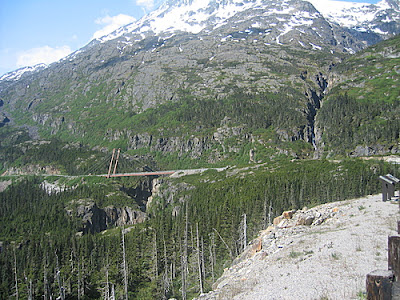
Skagway's claim to fame was that it more or less existed to fleece the prospectors on their way up the White Pass to the Klondike gold fields in Canada. Skagway is at the head of an inlet that is as close as you can get to the Klondike by sea and from there you had to cart yourself and your gear over some mountains into Canada. The big tourist attraction is the White Pass and Yukon Railroad, a narrow gauge railroad built to carry miners etc. up the White Pass into Canada. It was literally carved out of solid rock in the sides of the mountains in the pass. We had taken this ride the last time we cruised Alaska, so this time we opted for the cheaper and less time-consuming van ride up the modern road on the other side of the pass. The trip was quite enjoyable. Thanks to this road, Skagway does connect with the rest of the world through Canada unlike most of the other towns in the AK panhandle. However, if anyone is there for the first time I highly recommend the railroad - it's quite spectacular. Any way, our van driver was an interesting guy. As one of the 800 or so year-round residents of Skagway, he pretty much knew everyone in town and like many locals held about three jobs. Afterward, the van dropped us in the middle of Skagway and we wandered into a local tavern for some lunch. Michelle and I shared an amazing sandwich. I don't remember what the tavern called it but it was a what we called a Thanksgiving night sandwich. That is, it was turkey breast, stuffing and cranberry sauce with lettuce and tomato. It was served on thick slabs of homemade style whole grain bread and was probably better than anything we had eaten thus far on the ship. After wandering around the town a while, it was back to the ship. But first, I stopped at the train depot and got a deal on a W.P.&Y. R.R. T-shirt and baseball cap. Also, got a nice photo of their one steam locomotive chugging along with a cruise ship in the background - kind of sums up Skagway.


We drove over this bridge on the way up the White Pass. It's supported only on one side because it crosses a fault line.

A waterfall in the White Pass

The W.P.& Y. R.R. steamer with cruise ships in background. "Radiance of the Seas" is to the right.


Next: A Native American fishing village and whale-watching.

Sunday, July 29, 2007

North to Alaska

This seems to be sort of turning into a travel blog, but Michelle and I just got back from a two-week jaunt to the 49th State. Thought I'd post some thoughts on it here.

Our first stop was Vancouver B.C. where we were to board the Royal Caribbean Lines' "Radiance of the Seas" for the north bound journey to Seward AK via several stops on the Alaska Panhandle (the Southeastern part of AK that stretches alongside Canada toward Seattle). We got there the day before we were to board and stayed overnight at a hotel near the Vancouver airport in order to preclude any horror shows perpetrated by late flights, lost luggage etc. As it turns out, everything went smoothly with flights and luggage. Also, due to the vagaries of flight scheduling and time change we arrived in Vancouver about 10:30 AM. At that point we made a decision not to spend our one day in the city sitting on our butts in the hotel but instead to take a Vancouver city tour and see the place. It was a good decision. We booked a four-hour city highlights tour for the afternoon and off we went.


Vancouver seen from the top of the Harbour Centre Tower


Vancouver is a really lovely city with what seems to be an excellent quality of life and it is surrounded by considerable natural beauty. It's located on a peninsula among various bays and river deltas. As a result it has excellent deep water port facilities along with many recreational areas such as beaches and small boat marinas. Our tour was on a bus with a number of stops throughout the city. The tour guide was very knowledgeable about the city, but he was also a bit of a character. For one thing, he ended every statement with "eh". Now I know this is supposedly a common practice in Canada, but he did it so much it was almost a caricature - he reminded me of the Mackenzie brothers, the two beer-drinking mock Canadians on the old Second City TV show. He also claimed to be a drummer in a rock band and an expert on the city's various micro-brews. He may have been that last thing-I tried a pint of his recommended beer and it was quite good. Anyhoo, the tour took us to Stanley Park, a green oasis of a peninsula adjacent to downtown, and various sections of the city including Chinatown, "Gastown" (a kind of hip restaurant and shopping district) and a stop to take the elevator to the top of the Harbour Centre Tower which is their version of the Space Needle but not as tall (but with a great view of the city). My favorite stop on the tour was called Granville Island. It is a small, artificial island in a creek near downtown and is sort of the Vancouver Greenwich Village. Lots of galleries, shops, theaters, and restaurants crowded into a walkable space and surrounded by water and boats. We ate dinner there in a Tapas bar called the Sandbar - it was quite good. To sum up: it was an enjoyable first day of vacation and the next morning we were up bright and early and off to the "Radiance of the Seas".


"Radiance of the Seas"


We showed up early for the boarding - they said 1:00 PM, but we got there at around 11:00 in the morning and pretty much walked right on the ship. We had a nice cabin with a balcony and kind of a sitting area; also, the bed was very comfortable. As for the public areas of the ship they were very tastefully done - lots of wood and artwork. The ship was fairly new so it had a huge central atrium that ran from deck 4 to deck 11 with glass-enclosed elevators. It had the other usual cruise ship stuff: a theater for evening shows, a casino (where I actually won at Blackjack unlike Las Vegas) and lots of bars including a nice piano bar with a fairly talented chap who played and sang requests. Of course since it was a cruise they pretty much fed you continuously in various places around the ship. Unfortunately, the food was for the most part not outstanding. It was decent but I've personally had much better on other cruise lines. But we went to see Alaska, so stuffing our faces was secondary. Enough description of the ship, if you've been on one modern cruise ship, you've been on them all.
After a day at sea we docked at our first port: Ketchikan Alaska. We booked two shore excursions there: a crab boat trip and "feast" and "The Great Alaskan Lumberjack Show". The crab boat trip was on a sort of enclosed patio boat where they took you up an inlet to some crab pots which they hauled out for some marine biology type measurements on the Dungeness crabs they caught. They then let the crabs go. It was moderately interesting. The best part was the "feast". They took us back to a lodge along the inlet and fed us mass quantities of steamed Alaskan Dungeness crab. These are not the king crab caught on the "Deadliest Catch" TV documentary. They are actually caught like our east coast blue crabs in salt water inlets and bays. They resemble our crabs a little but they seem to be meatier and the meat is sweeter. Eating them is similar to eating the blues - basically a slob's convention of cracking claws and digging out meat with bits flying all over the place - great fun! The feast included one beverage of choice. Fortunately one of the choices included a pint of Alaska Amber beer. Mmm, steamed crabs and good local brew. Doesn't get much better than that.

Me, stuffing my face with Dungeness crab


After the feast they bussed us back to the dock and it was a two-block walk to the lumberjack show. It was fun watching them saw huge logs and climb tall poles and try to log roll one another into a pond. It was staged in the form of a good natured competition between two teams with lots of clowning and shouting. After that, it was back on the ship and off to Juneau. More on that tomorrow.
The Great Alaskan Lumberjack Show

Tuesday, June 19, 2007

Happy Birthday Kathleen


Yesterday was June 19th, which is a day of some historical significance - it was the day in 1865 when the Union Army showed up in South Texas and finally informed the slave population that they were free, two years and more after the Emancipation Proclamation. As such, it rightly has great significance to African-Americans in Texas and elswhere in the U.S. who traditionally celebrate it as "Juneteenth".


June 19th also happens to be the birthday of my all-time favorite actress: Kathleen Turner. Most people probably remember her from her earlier film work in the 1980's. She was best known back then for her debut film : the very sexy and steamy neo-noir "Body Heat". Other 80's films for which she is known include: "Crimes of Passion", "Romancing the Stone", "Jewel of the Nile", "Prizzi's Honor" and "Peggy Sue Got Married".

Kathleen turned 53 yesterday, and while she is certainly not the lovely young actress from the 1980's anymore, she is still an attractive and striking woman. More important than her looks however is the fact that if anything, her skills as an actress, which were excellent in her younger days, have become even better. Once she became "too old" to be a conventional Hollywood leading lady, she reinvented herself as a stage actress (actually she has been doing stage work throughout her career). I believe that it is on the stage that she has done her best work.

Specifically, she has just finished a nationwide tour of the Edward Albee play "Who's Afraid of Virginia Woolf". Previous to the tour, the play was seen in New York City and London. I had the privilege of seeing the play in 2005 in New York. Ms. Turner was wonderful in the role of Martha. She and Bill Irwin, the actor who played opposite her in the role of Martha's husband George meshed their skills and their characters' personalities to create an amazing, funny, and poignant experience for the audience.

The best part was after the show, Ms. Turner and Mr. Irwin stood outside the theater's stage door signing autographs and I was fortunate enough to exchange a word or two with Kathleen as she graciously signed my copy of Playbill. Needless to say, that Playbill remains one of my prized possessions.


Kathleen Turner signing autographs in New York City.


For a Wikipedia synopsis of "Who's Afraid of Virginia Woolf" go here: http://en.wikipedia.org/wiki/Who


At any rate, Happy Birthday Kathleen.

There are some other things to report in my fairly boring life, but they shall have to await the next posting.