 The GPO on O'Connell St. The Irish freedom fighters of 1916 occupied the building. After bitter fighting they were forced to surrender to British forces.
After the rising was put down, the British executed a number of its leaders as a stern warning. Like most such brutality, it backfired, creating martyrs and winning more support for the cause of independence.
 A statue of Daniel O'Connell, who won the right for Irish Catholics to vote, be elected to Parliament, and enter the civil service.
 This angel decorates the base of the O'Connell statue - note the small hole near her elbow; it is a bullet hole from the Easter Rising.
 This statue is on O'Connell St. near the GPO. It is James Larkin a founder of the Irish labor movement.
 A statue of Daniel O'Connell, who won the right for Irish Catholics to vote, be elected to Parliament, and enter the civil service.
 This angel decorates the base of the O'Connell statue - note the small hole near her elbow; it is a bullet hole from the Easter Rising.
 This statue is on O'Connell St. near the GPO. It is James Larkin a founder of the Irish labor movement.
At any rate, the bus continued along O'Connell St. and across the Liffey taking us past a number of Dublin historic sites. I'll post some pictures Abe took along the way.
 A street in Dublin
 The river Liffey - sometimes referred to as "Anna Liffey" in Irish song and poetry
 A side street in Dublin. The weird yellow thing coming at you is an amphibious vehicle which is used to give harbor tours. The US Army used to call them "Ducks".
 Some of the lovely Georgian row houses for which Dublin is famous. The doors are often decorated with much pride and individuality.
 One such Dublin row house door.
 The Bank of Ireland - this building was originally the Irish Parliament House in the 1700's
 The offices of the Taoiseach or Prime Minister
 St Patrick's Cathedral - interestingly, it is a Protestant Church of Ireland (Episcopal) cathedral
 A statue of "Molly Malone", Dublin's favorite fish monger. Who knew she had such cleavage? The tour guide on the bus told us some blarney/malarkey about her supposedly "moonlighting" as a hooker (not that she actually existed - it was a song). Dubliners call her the trollop with the scallops.
 A street in Dublin
 The river Liffey - sometimes referred to as "Anna Liffey" in Irish song and poetry
 A side street in Dublin. The weird yellow thing coming at you is an amphibious vehicle which is used to give harbor tours. The US Army used to call them "Ducks".
 Some of the lovely Georgian row houses for which Dublin is famous. The doors are often decorated with much pride and individuality.
 One such Dublin row house door.
 The Bank of Ireland - this building was originally the Irish Parliament House in the 1700's
 The offices of the Taoiseach or Prime Minister
 St Patrick's Cathedral - interestingly, it is a Protestant Church of Ireland (Episcopal) cathedral
 A statue of "Molly Malone", Dublin's favorite fish monger. Who knew she had such cleavage? The tour guide on the bus told us some blarney/malarkey about her supposedly "moonlighting" as a hooker (not that she actually existed - it was a song). Dubliners call her the trollop with the scallops.
I have to say that the bus tour was fun, the tour guide regaled us with a combination of real history and pleasant blarney. Supposedly, Dubliners are noted for having a wry or even warped sense of humor even for Ireland. Well this guy had one and we loved it.
Its was getting on about lunchtime at this point and, as the bus was approaching the stop for the Guinness tour, we decided to hop off, take the tour and get something to eat.
There is no longer a tour of the actual brewery. Instead, you tour the "Guinness Storehouse" which contains various exhibits, a restaurant, bars etc.
 Roz at the entrance to the Guinness storehouse
 A sign welcomed us to the tour
 This sign pretty much explains the process demonstrated in the exhibits
 After touring we ate lunch at the Guinness restaurant located on an upper floor of the building. This was the view from our table.
 The final phase of the tour was a free pint in the "Gravity Bar" on the top floor. Roz and Michelle enjoy some of Ireland's finest.
 The view from the Gravity Bar
Its was getting on about lunchtime at this point and, as the bus was approaching the stop for the Guinness tour, we decided to hop off, take the tour and get something to eat.
There is no longer a tour of the actual brewery. Instead, you tour the "Guinness Storehouse" which contains various exhibits, a restaurant, bars etc.
 Roz at the entrance to the Guinness storehouse
 A sign welcomed us to the tour
 This sign pretty much explains the process demonstrated in the exhibits
 After touring we ate lunch at the Guinness restaurant located on an upper floor of the building. This was the view from our table.
 The final phase of the tour was a free pint in the "Gravity Bar" on the top floor. Roz and Michelle enjoy some of Ireland's finest.
 The view from the Gravity Bar
After the tour of the "Storehouse", we hopped back on the bus for the trip back to our starting point. Once back by the GPO, we decided to cross the O'Connell St. bridge on foot to explore an area of Dublin called the "Temple Bar". This is a neighborhood along the south bank of the Liffey which contains many pubs, restaurants etc. It is a very lively area and seems popular with young people.
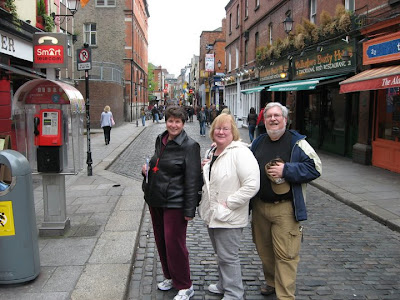 Roz, Michelle and I on a cobblestone street in Temple Bar
 Roz, Michelle and I on a cobblestone street in Temple Bar
We wandered about the district checking out some of the sights and the pubs until hunger pangs once again overtook us. We found a pub with food and live music and settled in to soak up some local color (as well as food and booze).
 Roz in front of "The Oliver St. John Gogarty"
 Roz in front of "The Oliver St. John Gogarty"
The pub was named after a historical character of early 20th century Dublin: Oliver St. John Gogarty. He was, among other things, a physician, poet, author, and participant in the Irish war for independence. Gogarty was also a sometime friend of James Joyce and purportedly served as the model for Molly Bloom's lover Blazes Boylan in "Ulysses". At any rate, the place had all sorts of paintings of famous Irish literati.
 Inside Gogarty's Roz cozies up to Oscar Wilde and William Butler Yeats - she just can't resist those Celtic literary types! Must be her librarian's training.
 Michelle and I in Gogarty's
 Abe and Roz sat across from us.
 Inside Gogarty's Roz cozies up to Oscar Wilde and William Butler Yeats - she just can't resist those Celtic literary types! Must be her librarian's training.
 Michelle and I in Gogarty's
 Abe and Roz sat across from us.
The music was lively and the food and beer were good. At this point we decided to call it a day and made our way back to the Luas on Abbey street and thence back to our car and our B&B.
Next: Trinity College and the Book of Kells
Next: Trinity College and the Book of Kells


